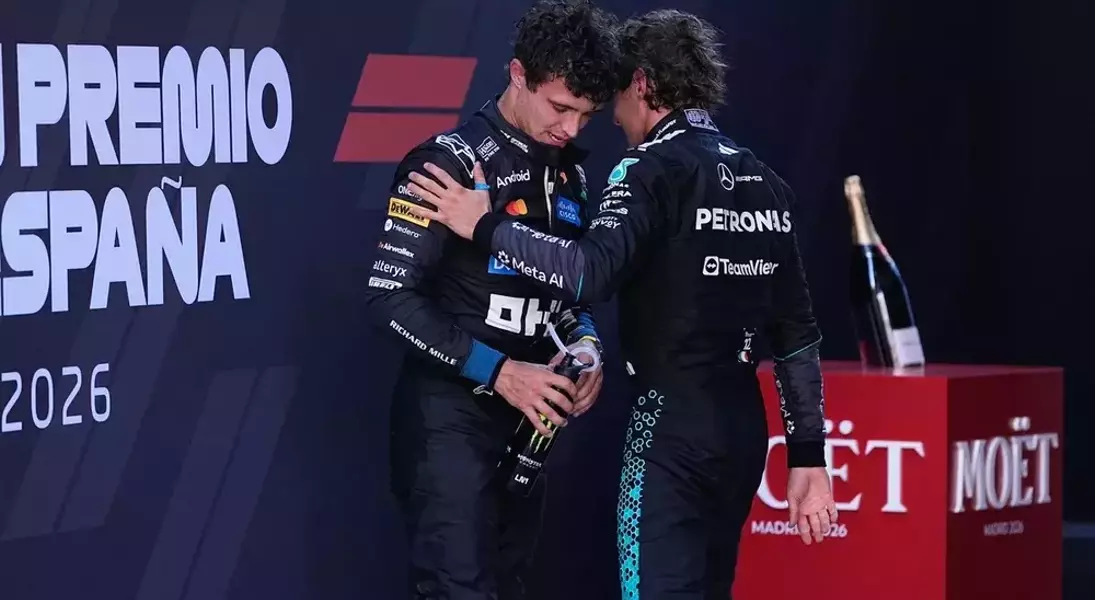
A critical two-second interval irrevocably altered the trajectory of the Spanish Grand Prix for Lando Norris, transforming a seemingly assured victory into a missed opportunity. This minuscule window separated Norris's car from the pit lane entrance and the subsequent activation of the virtual safety car (VSC), an incident that ultimately steered the win towards Kimi Antonelli. Norris had established a formidable lead of 6.2 seconds over Antonelli by the 14th lap, exhibiting masterful control after navigating a tumultuous opening lap where his primary rival, the championship leader, made several errors off-track. His commanding performance suggested an impending comfortable win until Lance Stroll's Aston Martin experienced a brake failure at Turn 20, abruptly bringing an end to his race and triggering a chain of events that would redefine the outcome for Norris.
The sequence of events unfolded rapidly, beginning with Stroll's car coming to a halt at Turn 20. Stroll's struggle with failing brakes, a similar issue that had affected Lewis Hamilton earlier, prompted him to strategically pull over near a marshal's post. While a yellow flag was immediately deployed, McLaren opted against a pre-emptive pit stop for Norris, as there was no immediate indication of a full VSC deployment. Team principal Andrea Stella later acknowledged the difficulty in making such a call, citing the severe penalty of a misjudged early stop. However, as Norris completed the final two corners of the track, the VSC was called, precisely two seconds too late for him to enter the pits. This timing allowed Antonelli, who was trailing by 6.3 seconds, along with Max Verstappen and George Russell, to capitalize on a 'cheap' pit stop, gaining a significant advantage by switching to hard tires under VSC conditions. Norris was left with no option but to complete another lap, facing the risk of the VSC ending before he could benefit from a discounted stop. When he eventually pitted after the VSC was lifted, a slow front-right tire change further compounded his misfortune, though McLaren suggested it didn't materially alter his final position behind Russell, Verstappen, and Antonelli. The team's radio communications reveal the rapid-fire decision-making under pressure, with calls for Norris to pit regardless of the VSC status.
The central question lingering after the race was whether McLaren should have extended Norris's stint on track to build a larger buffer. With Charles Leclerc inadvertently slowing down Verstappen and Antonelli, a strategic delay could have potentially allowed Norris to establish the crucial 30-second lead needed to re-emerge ahead of Antonelli, or at least behind Leclerc. However, Norris was on aging medium tires, and his pace advantage over Leclerc, who was on hard tires with minimal degradation, was steadily diminishing. The data showed that his per-lap lead over Leclerc was shrinking, making it mathematically impossible to create the necessary gap of at least 16 seconds once the VSC was lifted. McLaren found themselves in an unenviable position, ultimately choosing the less risky option, which unfortunately resulted in a loss of victory due to sheer bad timing. As Stella aptly summarized, it was an almost 'mathematical definition of being unlucky', highlighting the unpredictable nature of racing where even optimal strategies can be undermined by unforeseen circumstances.
The Spanish Grand Prix serves as a poignant reminder that success in Formula 1 is a delicate balance of skill, strategy, and fortune. While Lando Norris and McLaren demonstrated exceptional performance, the swift and unforgiving nature of the sport ensured that a mere two-second delay could dramatically alter destiny. Such moments, though painful, underscore the relentless pursuit of perfection in motorsports, inspiring teams and drivers to continually refine their craft, anticipate the unpredictable, and never cease striving for that elusive perfect race. It highlights the importance of resilience in the face of adversity, pushing everyone involved to learn, adapt, and return stronger, embodying the true spirit of competition.



















