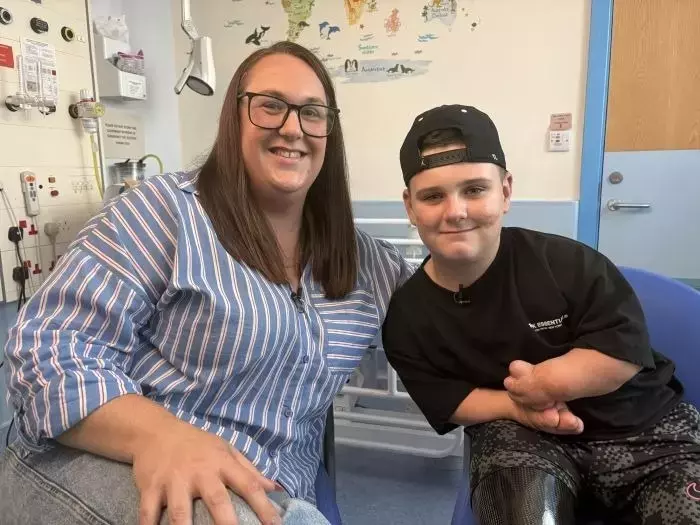
A remarkable medical breakthrough at Nottingham University Hospitals NHS Trust (NUH) has transformed the life of a young double amputee. Taylor, a 12-year-old boy, became only the second individual in the United States to benefit from a groundbreaking synthetic skin treatment. This innovative procedure has allowed him to reclaim the joys and activities of a typical childhood, demonstrating a significant leap in medical technology and patient care.
Taylor's early life was marked by extreme challenges. At just eight months old, he was afflicted with meningococcal septicemia, a severe illness that tragically led to the loss of several fingers and the amputation of both legs before his first birthday. Despite these profound physical limitations, Taylor, like many children his age, developed a love for social interaction, enjoying time with his friends, playing football with his grandfather, and showing promise as a table tennis player.
Throughout his growth, Taylor faced recurring difficulties with his prosthetic legs. The skin on his residual limbs struggled to adapt to the demands of growth and movement, resulting in frequent hospital visits and an increasing reliance on his wheelchair. This hindered his participation in many activities, leaving him feeling isolated. His mother, Terri, vividly recalls the decline in his quality of life before the pivotal MTX treatment, emphasizing it as the best decision they made for his well-being.
The innovative treatment involved NovoSorb MTX, a biodegradable synthetic wound dressing developed by PolyNovo. This advanced material acts as a scaffold, providing a framework for the body to generate new tissue. In Taylor's specific case, MTX was utilized alongside Biodegradable Temporizing Matrix (BTM) to promote the development of a thicker layer of new, robust tissue. This combined approach, approved by the Medicines and Healthcare products Regulatory Agency (MHRA) for this specific application, has yielded unprecedented results, offering new possibilities for complex wound management and reconstructive surgery.
Mr. Skaria Alexander, a Consultant Burns, Plastics, and Reconstructive Surgeon at NUH, highlighted the significance of the dermis layer, which provides crucial structural support, durability, and elasticity to the skin. He explained that MTX's utility lies in its ability to rapidly rebuild this dermal layer with fewer surgical interventions. This not only reduces stress for patients but also decreases theater costs and nursing time, making the treatment more efficient and less burdensome. Taylor's case stands as a testament to the success of this approach, with Mr. Alexander noting it as one of the most successful outcomes seen with MTX globally. The hope is that future patients can benefit from this treatment, minimizing the need for multiple reconstructive surgeries.
Anna Baker, Taylor's Clinical Nurse Specialist, who has supported him since his critical illness as an infant, has witnessed the profound impact of the treatment firsthand. She states that the treatment has been life-altering, with Taylor now rarely needing clinic visits. He can utilize his prosthetic limbs more effectively, attends school consistently, and actively engages in his beloved activities, moving beyond the confines of his wheelchair. Taylor himself expressed a sense of pride in being the second person in the US to receive MTX and the first globally to openly discuss its benefits, underscoring the groundbreaking nature of his journey.
Taylor's mother, Terri, affirms that the treatment has brought about a full year of stability and happiness for her son. He is now thriving and pursuing his passions, including joining a table tennis league with aspirations of competing in the Paralympic Games. His story exemplifies how advanced medical technologies can profoundly improve the lives of individuals facing significant physical challenges, offering a pathway to an active and fulfilling future.



















